Travel Greece


Discover inspiring destinations, practical travel tips, and hidden gems around the world. From vibrant cities to peaceful escapes, this guide helps you plan unforgettable journeys with confidence and ease. Your next adventure starts here.


The village of Foroglio, famous for its stone houses in the TRAVEL Swiss Alps, and its magnificent nature.


Antalya (Turkish pronunciation: [anˈtalja], from Ancient Greek: Ἀττάλεια) is the fifth-most populous city in Turkeyand the capital of Antalya Province. Turkey in the "capital of tourism" as seen. Located on Anatolia's southwest coast bordered by the Taurus Mountains, Antalya is the largest Turkish city on the Mediterranean coast outside the Aegean region with over one million people in its metropolitan area
The city that is now Antalya was first settled around 200 BC by the Attalid dynasty of Pergamon, which was soon subdued by the Romans. Roman rule saw Antalya thrive, including the construction of several new monuments, such as Hadrian's Gate, and the proliferation of neighboring cities. The city has changed hands several times, including to the Seljuk Sultanate in 1207 and an expanding Ottoman Empire in 1391.
Ottoman rule brought relative peace and stability for the next five hundred years. The city was transferred to Italian suzerainty in the aftermath of World War I, but was recaptured by a newly independent Turkey in the War of Independence.
Antalya is Turkey's biggest international sea resort, located on the Turkish Riviera. Large-scale development and governmental funding has promoted tourism. A record 13.6 million tourists passed through the city in 2019.


London has more museums than you could see in one visit, and many of them are free. From the Tate to the City Museum to the National Gallery to the Historical Museum, you’ll be able to spend days here without spending a penny! At the Natural History Museum, you’ll find over 80 million items, including specimens collected by Charles Darwin. It also has a great collection of fossils, making it a fun and educational stop if you’re traveling with kids. The Victoria and Albert Museum (named after Queen Victoria and Prince Albert) is another favorite of mine. It’s home to over 2,000 works of art covering over 3,000 years of human history.
With more food stalls than you can imagine, Borough Market has something for every eater. It is home to some of the best British and international produce and dishes. Come here hungry and leave satisfied. Already ate? Nibble the free samples being given out at most stalls. Open for lunch Mondays and Tuesdays, all day Wednesday-Saturdays and closed on Sundays. The crowds are terrible on Saturdays, but if that’s the only day you can fit it in, I’d go anyway!
London is known for its’ famous theater scene. Attend a show while you’re here and see some of the shows that make London famous. Tickets can be pretty cheap, and something is playing every night (check out TKTS for discounted tickets for shows in the West End). Otherwise, catch a Shakespeare show at The Globe in South London — tickets start from £7 ($10 USD).
On Sunday, this little street, and the car park becomes a great place for cheap food. You can get a wide variety of food here, spend the day at the outdoor market, or have some great local curry. It’s a popular place with the locals and has some of the best food in London. This street is also a great place to bring a camera, as its’ walls are basically a gallery for London’s best graffiti artists.
The London Eye is basically a 500-feet tall ferris wheel, and it has become the most popular paid-for UK visitor attraction. It’s across the street from Parliament and gives you great views of London, especially on a clear day. But honestly, for £27 ($35 USD), you are better off spending that money on other attractions.
The London Dungeon calls itself “the world’s most chillingly famous horror attraction.” It covers 2,000 years of London’s gruesome history and is a morbid but interesting museum to see about England’s past. Although you’ll learn about popular torture methods in Old England, to be honest, this place has turned into more of an “amusement park” type attraction. But if you like things like escape rooms and scary boat rides, you’ll enjoy it. Ticket prices start from £24 ($31 USD).
St. Paul’s is a striking cathedral with a world-famous Dome. Inside you’ll find glittering mosaics and elaborate stone carvings. You can also climb to the Whispering Gallery or higher still to the Stone Gallery or Golden Gallery for panoramic views over surrounding London. Admission is £24 ($31 USD) when you buy online, which is cheaper than the London Eye and with similarly breathtaking views.
Covent Garden is a fun place to just hang out, with lots of quirky stalls, busking musicians, an artsy market, and a selection of unusual pubs and coffee shops. Covent Garden is also walking distance to all the big musicals, so it is a great place to spend a few hours before catching a show. Also, visit Covent Garden Market – it was opened in the 1830s and is another good market to grab a bite to eat at as well as shop at some of the artisan craft stalls here. It’s open Monday to Saturday from 8am-7pm and Sunday 11am-5pm.
An integral part of England’s history, the Globe Theatre is a must-see for lovers of Shakespeare. The performances here are considered to be a near-perfect replica of Elizabethan staging practices. You can even sit in front where the groundlings did, for shouting and heckling! The theater is open-roofed, so bundle up in the winter. Tickets start from £7 ($9 USD).
This place is home to 1,000+ shops, stalls, cafes, restaurants, bars, buskers, and everything in between. It’s enormously popular and busiest on the weekends, particularly Sunday, drawing crowds all the way from Camden Town. Camden Market is actually composed of many separate markets, so you can literally wander for hours and not see it all.
Since its 17-million USD renovation, this observatory is now divided into two sections. The Northern half is intended for time, whereas the southern half is devoted to astronomy. In the Meridian Courtyard, you can actually stand on either side of the meridian line straddling the two hemispheres of the Earth. The Peter Harrison Planetarium is also housed here. It’s £24 ($31 USD) to visit.
In the 12th century, rich noblemen built elegant homes and gardens along the shore (the strand) of the Thames, making it one of the most prestigious places to live — even now. Walk around here, and you’ll be treated to a grand display of wealth and beauty. It was dubbed “the finest street in Europe” by Prime Minister Benjamin Disraeli in the 19th century. There are a lot of nice little shops and pubs here as well.
This old pub has been around since the great fire of 1666 (and there has been a pub at this location since 1538). It’s surprisingly large inside, and in the winter, fireplaces keep pub goers warm. When you step into it, you feel like you’ve actually stepped back in time. Famous literary geniuses like Charles Dickens, R.L. Stevenson, Mark Twain, Oliver Goldsmith, and others used to frequent (and write about) this particular pub.
Located beneath the Treasury Building in the Whitehall area of Westminster, the Churchill War Rooms includes the government’s command center during WWII and a museum about the life of Winston Churchill. The centerpiece of the whole place is an interactive table that enables visitors to access digitized material from the Churchill archives. If you are like me and a huge history nerd, this is one of the best attractions in the city and I highly, highly encourage you to visit. It’s worth the price!!! Admission is £22 ($29 USD).
If you’re looking to get away from the hustle and bustle of the city, head to Hyde Park or Kensington Gardens for some reprieve. Hyde Park is the most famous park in London. Originally the private hunting grounds of Henry VII, it opened to the public in 1637 is is a great place to stroll, picnic, or catch one of the many events that are hosted here throughout the year. Kensington Gardens are a Royal Garden of London and is home to the Serpentine Galleries as well as Kensington Palace. The park and the gardens cover almost 250 acres!
London is a megacity filled with a mega amount of walking tours. From free tours to specialty tours to paid tours to literary tours to quirky tea tours, London has it all – including lots of free tours. Free London Tours and New Europe Walking Tours are some of my favorite companies to go with. If you’re looking for more in-depth and specific tours, check out Take Walks.They have a number of affordable group tours for 15 people or less that last about three hours.
Every night, you’ll find tons of people in the East End learning about Jack the Ripper on a ridiculous number of similar tours. My favorite is the original Jack the Ripper Tour. Get Mick as your guide; he’s obsessed with Jack the Ripper (he even wrote a pretty decent book on the subject) and will fill you with arcane knowledge. Very animated too! Tours start from £15 ($19.50 USD).

The iconic image of the pyramids, with its backdrop of endless desert, is a clever trick, as we discover after navigating the congested highways of Cairo, a city of 22 million people. The Giza Pyramids complex lies on the west bank of the Nile, on the city’s outskirts, barely a stone’s throw from the crammed high-rises and bustling bazaars of the sprawling metropolis.
Still, nothing can detract from the majesty of Giza, one of the Seven Wonders of the Ancient World. The UNESCO Heritage-listed site is home to six pyramids; magnificent burial tombs built for the kings of the 4th dynasty around 4,500 years ago. This includes The Great Pyramid, built for King Khufu, and its cloud-grazing 480ft (146m) apex. Keeping loyal guard is the Sphinx – a mythical hybrid of human and lion.
In the shadow of the pyramids, camel owners seek shade for their animals on breaks, in between offering 15-minute rides at a cost of around US $30. Even having your photograph taken with one can cost around US $10. Though the majority of the camels look healthy and well-cared for, it’s an activity that does not sit well with every traveler.
We each pay US $11 to join the queue to go inside Khufu’s Pyramid. A fairly steep (and slightly scary) descent on a narrow wooden walkway takes us to the inner chamber. I’m expecting to be blinded by a dazzling haul of treasures, but the tiny room is airless and threadbare, stripped of its treasures thousands of years ago by opportunistic robbers. Thankfully, I don’t suffer from claustrophobia, but the experience is a little anti-climactic.
Due to open towards the end of 2020, hopes are high that the new, $1 billion Grand Egyptian Museum will put Cairo firmly back on the tourist map, following a difficult few years in the wake of the 2011 revolution and several terrorist attacks. The impressive modernist glass construction – which will feature an earth-to-heaven viewing platform of the pyramids, is being heralded as the largest archaeological museum in the world.
I visit the current museum, the Egyptian Museum of Antiquities, an oasis of calm in the heart of the frenetic capital city. The red-hued building has a faded colonial charm and houses an incredible 120,000 artefacts. For an entrance price of just US $4, many of the rare treasures we’d expected to see inside the pyramids are on display here. This extends to the pharaohs themselves; many discovered in The Valley of The Kings, the world-renowned royal burial ground on the Nile’s west bank.
A US $6 ticket allows you entrance into the Royal Mummy Room. However, it may not be for everyone; gazing upon the preserved kings and queens makes for a unique, if unsettling experience. The ‘star’ of the exhibition is Ramses I. His mummified remains are almost perfectly intact, and we fall into an awed silence when it dawns on us that we’re looking at the (reddish) hair and teeth of a man who walked the earth over 3,000 years ago.
The somber atmosphere lifts when we move on to the other main draw of the museum, the King Tutankhamun collection. He is the most well-known Egyptian pharaoh, despite only ruling for a short while. The ‘boy king’ was only nine years old when he became ruler.
In 1922, British archaeologist Howard Carter unearthed an outstanding collection of treasures in Tutankhamun’s tomb in The Valley of The Kings, which revealed the Egyptian’s belief in the afterlife. These include King Tut’s solid gold bed, his intricately carved throne and chariot, plus hundreds of other everyday items, all buried to make the Pharaoh’s next life as comfortable as possible.
We only have a couple of hours at the museum, not enough time to truly appreciate the incredible haul of artefacts. However, the current space doesn’t do the priceless exhibits much justice and the new museum, which will cover a space of over 50 hectares should solve that problem. If I needed an excuse to return, this is it.
I’ve never really ‘got’ cruising. Why would you want to be stuck on a ship for hours on end, wasting precious time to explore on land? However, when I jump onboard the Medea, my home for three days as I travel from Luxor to Aswan, that changes instantly.
It turns out to be the perfect way to explore the Nile and the treasures that line its west bank. I’ve lucked out with my accommodation: a cabin at the ship’s bow that offers 360º views.
Ploughing gently through the biblical waters, we see rural villages little changed by time. Oxen bask lazily in the midday heat and children play on the river banks, stopping to wave and squeal excitedly at the passing boats.
Cruising also offers a great way to hop off to visit the temples, including Kom Ombo, the only one dedicated to two gods: the crocodile-headed Sobek and falcon-headed Horus the Elder. Many still have intact hieroglyphics adorning their walls, providing a fascinating insight into Egyptian culture.
I’m getting used to extremely early starts on our tour. It’s not unusual to have 5am alarm calls, as the mercury can nudge 89ºF (32ºC) by midday (even in October when I’m there), so getting up early is a practicality of traveling here.
When night descends, I hear haunting calls to prayer from the mosque’s minaret towers on both sides of the river. It’s a sublime experience.
Just as the ancient Egyptians relied on the waters of the Nile to sustain all life, the tourism industry is essential for survival today. After a difficult few years, around 8.3 million visitors were recorded in 2017 — nearly double those in 2015 – and officials are optimistic the upward swing will continue.
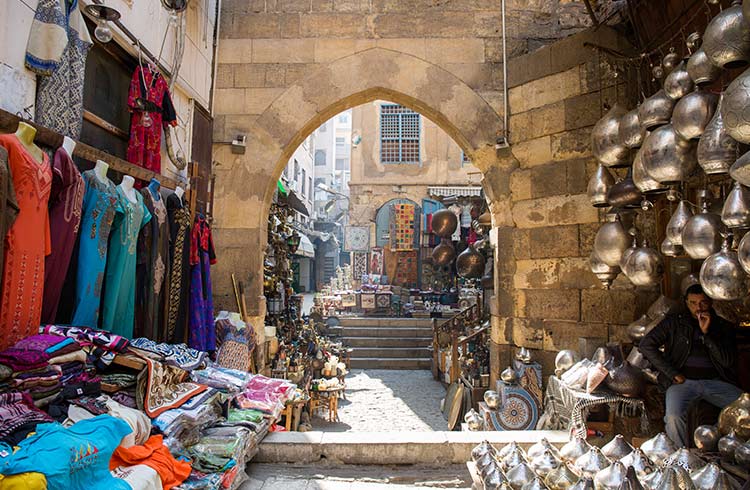
Everywhere I go, I see hawkers selling every souvenir under the sun. Our guide advises us it’s common practice to cut the original asking price by half and start from there. As a dedicated shopper, his advice helps me gather an impressive stash of souvenirs, but the friendly bartering is definitely the best part of the experience. Always check to make sure the souvenirs you purchase are ethically made and authentic, and be especially wary about anything made from camel bone.
However, I’ve learnt on my travels that sellers around the world can spot a soft target at 10 paces. My theory is proved when we visit an alabaster museum in Luxor. It starts innocently enough: I smile at the family sitting on the bench outside; a father smoking an elaborate hookah (a traditional pipe) with his four children. When they wave back and motion me to come over, I have hopes of getting a great photograph.
Before I know it, I’ve been invited to sit down and enjoy some shisha (flavored tobacco). The children giggle at the British woman with bright copper hair who is temporarily hanging out with the family. But of course, I’m expected to pay for the privilege. Personally, I think it's more than a fair exchange and am happy to offer US $10 to have my tour buddy capture the moment on my iPhone, though it serves to highlight there's an expectation that you’ll pay for these 'authentic' interludes.
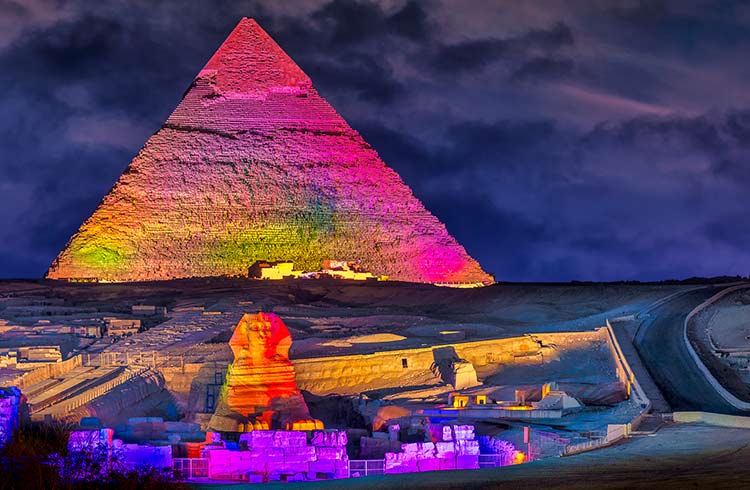
To mark our last evening in Egypt, we head back to the Pyramids for The Sound and Light Show. As night falls every evening, the 45-minute show follows a timetable of different languages to suit all visitors. Admission is around US $14 – don’t spend US $17 on the front-row seats because you get the same views for the cheaper ticket.
Our expectations for a thrilling laser extravaganza are quickly dashed. The ‘light’ part of the show consists of the Pyramids being illuminated in a rainbow of colors and a ‘face’ being cast onto the Sphinx. A booming voice, reminiscent of an epic British biblical 1950s movie (think Charlton Heston in Ben Hur), crackles over the speakers to take the audience through the history of the pharaohs.

Subscribe to
Posts [Atom]


